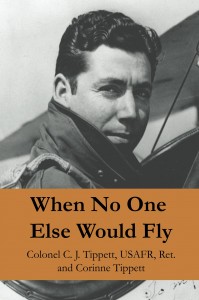






Before he was a Colonel, C. J. Tippett flew the Lycoming Stinson out of Clover Field in California.

Before he was a Colonel, C. J. Tippett flew the Lycoming Stinson out of Clover Field in California.

One of my blog post series about my grandfather’s aviation pioneering life is “Where In The World… On This Day”… because he left such an awesome, museum-quality collection of documents, photos, logs, articles, memos, letter, photos and more that I can track where he was on a given day. Like today, for instance.

76 years ago, on May 16th, 1937, Tip was beating the Sunday sunrise at Clover Field, Santa Monica, California. He was running pre-flight checks on a Lycoming Stinson, registration number NC-13843. I know this from his pilot’s log, which he not only kept in great detail, but he had it notarized and signed off with each new flight certification. At age 24, he was aiming for a career as commercial pilot and he needed this flying time to count.

He would eventually go far beyond the career of a commercial pilot. He would become the Director of the South American Office of the International Civil Aviation Organization – and more. The story of his life, including his flights out of Clover Field, is told in his own words, as well as with my background, in “When No One Else Would Fly,” soon to be available on Amazon.com.

The Lycoming Stinson that Tip was flying that day was a day hire. Tip often flew passengers, flight students, or business men needing fast transport out of Los Angeles. Or he traded flight time with local fleet operators, but he flew almost every day. In this way, Tip flew every model of aircraft that was commonly available on 1937 civil aviation airfields, and some that were not so common.

The Lyoming Stinson was also known as the “Reliant.” It was a tail dragger, meaning that until the pilot had enough runway speed to take off, his view out the windshield was of everything except the ground in front of him. The airplane had a single overhead wing, and one engine on the nose. It could carry two passengers in addition to the pilot. True to its name, it was reliable and rugged.

“Lycoming” refers to the engine, and “Stinson” was the aircraft’s maker. This common standard for referencing aircraft in Tip’s day illustrates how important the two pieces of information were to pilots like Tip. The engine and the aircraft were two separate entities, and Tip knew them both intimately well.

Clover Field was the flight testing base of the Douglas Aircraft Company, and the maiden runway for the Douglas DC-3. Tip also knew that aircraft and company well, as they provided his day-job when he wasn’t flying overhead… as he did on Sunday, May 16th 1937.


Trying to determine monthly book sales from the Amazon Best Seller Rank is not black and white.

Trying to determine monthly book sales from the Amazon Best Seller Rank is not black and white.

How does Amazon sales ranking relate to monthly book sales?

Nobody knows. Except maybe Amazon, and they aren’t telling.

But some very determined, diligent, and intelligent people have taken on the challenge of trying to find an answer – and they’ve posted some tools and guides.

They are mostly authors who have self published books for sale on Amazon.com and have found, as I have found, that there is no way to independently verify how many of our books have sold on Amazon.com. We have to settle for Amazon’s report each month… and be patient with the fact that some kinds of sales have several weeks delay in posting on that report.  (I should say here that this whole situation isn’t much different from having to rely on a traditional publisher for a report of monthly sales – and in those cases, the delay can be much longer… but still… inquiring authors want to know.)

At first I wanted to know because I was concerned that maybe I was selling hundreds of thousands of books but only getting paid for about ten. But once I cruised the reports and sites and saw the general overviews of Amazon book ranking translated to estimated overall monthly sales, I accepted reality, (not really, but I pretended to)… and Amazon’s reporting.

Then I wanted to know how many books other authors were selling, particularly my favorite authors or some of the successful self published authors I’ve been following.

Amazon.com shows a book sales ranking as Amazon Best Seller Rank, under Product Details” on the book’s Amazon.com listing – you scroll down past “Description,” past “Customers Viewed This Item Also Viewed,” past “Editorial Reivews,” and you are there.

The rank changes every day, depending on your own book sales, and other people’s book sales. It is a complex algorithm (or a bingo cage at Amazon headquarters) and it can be very volatile.

The most interesting thing about the ranking is the general number range; like less than 100,000 or more than one million. All the info I’ve gathered about this number range is from people observing on their own, not from Amazon.com’s CFO, but I’ve done enough of my own double checking (on my own numbers and through other sources) that I think it is somewhat accurate.

In general, if your ranking is less than 100,000, you are probably selling several books every month. If your ranking is more than one million – meaning that there are at least one million better selling books on Amazon.com than your book… you are probably only selling a couple of books a month (or less), or haven’t sold a book in a couple of weeks (or more) – and you should probably stop checking your ranking and start doing more marketing.

But sell two books in two weeks and watch that ranking climb!  For one day.

Another resource, which is far more iffy, is a site that offers you a chance to enter your actual sales ranking and see what you actually might be selling monthly or daily. I found this calculator a little buggy – make sure you zero it all out and try it several times with slightly variable numbers. But it did show me numbers that made sense on my own ranking, and some test rankings where I already knew the monthly sales of other books.

There are also sites that helpfully offer, for free, to track your Amazon.com sales ranking; presumably so that you can have an average to plug into the calculator.

For me, having yet another numerical measure in my life is unappealing, especially because it does not generally make it under 100,000 on any given day, so I am satisfied with the occasional overview.

I could toss it into my goal pile, but instead, I’m going to get ready to release my grandfather’s aviation biography and see what happens to THAT sales ranking… wahOOOOOO!


Colonel C. J. Tippett in the cockpit of a Lockheed T-33 in Panama, 1955 - 1960

Colonel C. J. Tippett in the cockpit of a Lockheed T-33 in Panama, 1955 – 1960

For Colonel C. J. Tippett, aviation pioneer and Director of the South American Office of the International Civil Aviation Organization in 1960, active duty orders were literally a license to fly…. the T-Bird, the Lockheed T-33 jet trainer!

Tip, while living and working in Lima, Peru, had qualified in the T-33 in 1955 and any chance to report for duty at Albrook Air Force Base in Panama was a chance to climb into the T-33 cockpit.

Tip’s orders speak for themselves:

“Headquarters 

Caribbean Air Command 

United States Air Force 

Albrook Air Force Base 

Canal Zone 

Reserve Orders Number 13 May 5, 1960

Personnel Data: By direction of the President Colonel Cloyce J. Tippett AO (redacted) (Ready Reservist) (Command Pilot-On Flying Status) (Primary AFSC-redacted) (Present Address: Apartado redacted Lima Peru) is ordered to active duty for a period of 15 days for the purpose of training.

Security Clearance: Secret.

Assignment: DCS/Operations HQ Caribbean Air Command Albrook Air Force Base Canal Zone.

Reporting Data: Effective date of training 16 May 1960. Report to DSC/Operations this headquarters not later than 16 May 1960. Officer will be released from organization assigned in time to arrive at place from which ordered to active duty on effective date of release from training 30 May 1960 on which date he will revert to inactive status unless sooner relieved. (this is not my syntax, I swear – it is gen-u-ine USAF order speakery)

General Instructions: Officer is authorized to participate in flying activities during the period of active duty covered by this order.

Authority: Paragraph 1b. AFR 45-28 6 3 1957.

Transportation: You will proceed from present address on effective date of training. Travel by military aircraft is directed when available. PCS. TDN. Pay and allowances are chargeable.

For the Commander: W.H. Fleetwood 

SIGNED CWO. W-4 USAF Asst Director of Administrative Services”

For more T-33 flight adventures, and the full story of Tip’s aviation history life, check Amazon.com for the book “When No One Else Would Fly” or contact us to be added to the list for upcoming release.


Positive thinking blooms when I use passwords as daily affirmations.

Positive thinking blooms when I use passwords as daily affirmations.

As a Do It Your Self Publisher, I have to log in to about twenty bizillion sites multiple times a day in order to self publish a book – including my own computer, my work computer, my voice mail, my work voice mail, my own phone, my work phone, … etc. The recent increase in internet hacking has led to an increase in password changing in my life – and now multiple logins on sites that used to require only one.

I’m trying not to see it as a pain in the rump, and instead as an opportunity for the practice of positive thinking since I recently changed over to creating passwords as daily affirmations.

And since the new passwords requirements are more stringent - for instance, not allowing me to change my password to something really really similar to my last password…. (schna!) I am scratching for words to express my positivity.

(And yes, I know that lame passwords are the real world equivalent of tying my car key on a really long string to the outside handle of my car door… but jeez. A bizillion random passwords are harder to remember than the location of my one car key!)

So I made a l helpful uber list of positive word synonyms so that I can work them into my new passwords and I decided to share them here on my blog, so that everyone can join me in trying to think up positive mini-mantras that do not contain my dog’s name, the word “password”, or something obscene – which while fun and affirming, was not very positive.

  • Love, adore, ally, amour, appreciate, cherish, delight, devote, enchanted, enjoy, fondly, friend, hanker, idolize, infatuated, like, regard, relish, repsect, worship, yearn, desire, prefer, want, wish, will, do, did, will do,
  • peace, accord, order, pacification, reconiliation, treaty, truce, unanimous, improve, advance, amend, better, boost, cultivate, elevate, mend, fix, elevate, rally, raise, shape up, upgrade, update, rise, revise
  • accomplish, achieve, acquire, attain, carryout, complete, deliver, do, effect, enact, finish, negotiate, perfect, perform, procure, produce…

Now that I think of it, I could also use my daily passwords to:

  • teach myself how to spell words that I always misspell,
  • or capitalizations I always miss,
  • or my new word of the month that I’m trying to learn.

Yet another way to turn a tedious chore into a positive moment!  And also, my second book is almost ready for release. Search Amazon.com for Corinne Tippett or join my book release list to catch the wave.

Colonel C. J. Tippett and his big, though not record-setting, and obviously not catch and release, black marlin rod and reel catch. at the Cabo Blanco Fishing Club in Peru.

Colonel C. J. Tippett and his big, though not record-setting, and obviously not catch and release, black marlin rod and reel catch, at the Cabo Blanco Fishing Club in Peru.

Colonel C. J. Tippett had the unique opportunity to participate in some of the best big game fishing in sport fishing history. The world record for black marlin fishing is still held by one of the men that Tip fished alongside, and from the waters where he fished. Alfred C. Glassell, Jr., caught the record 1560 pound black marlin at the Cabo Blanco Fishing Club in 1953, and Tip was there.

Tip himself caught black marlin, big-eye tuna, blue-fin tuna, mako shark, swordfish, sailfish, and held the world record for roosterfish until someone else caught a bigger one in the 1990s.

It was an amazing, exciting, glamorous time and when it ended, it wasn’t directly because of the sport fishing activities, but our modern eyes have qualms when we look at the size and species of the trophy pictures taken on the Cabo Blanco docks. Today, we know that those species are now endangered, and some of us wonder….

But rod and reel big game sport fishing was not, and is not now, the reason billfish populations are declining worldwide – it is longlining.

Longline fishing is a commercial fishing practice of setting baited hooks over miles and miles of open ocean. It kills large numbers of many species without regard to fish populations, sex, age, size, or season.

And it was the sport fishing industry who led the most vocal movement for a change in fishing laws – attacking not the commercial fishermen directly, but their marketplace instead. A far more effective method of influencing the fishing industry – which is, after all, a business.

The International Game Fish Association was a major champion of the recently successful Billfish Conservation Act, which prohibits the importation of all billfish (except swordfish) into the United States. Taking marlin off the menu in America.

The legislation was signed in 2012. The United States had been the biggest buyer of billfish catches in the world,
and now – it is not.

Several of the men who fished Cabo Blanco’s abundant waters in the 1950s went on to become highly recognized wildlife conservationists later in their careers. Conservation was not an active conversation point in the 50s;  time that saw the heyday of big game hunting, big game fishing, and record setting adventure.

The 1950s were the height of the Cabo Blanco Fishing Club’s fame and fortune, and Tip wrote about his adventures  as club director in the very-soon-to-be-released book, “When No One Else Would Fly“. Check Amazon.com for a copy, or join our b00k release notification list by contacting us.


It is Tulip Time here in Portland, and my bulbs of do it your self publishing are getting ready to bloom.

It is Tulip Time here in Portland, and my bulbs of do it your self publishing are getting ready to bloom.

I’ve blogged about this issue of definitions within the term “self publishing” before, but I am doing it again because I think it is so important…

This new publishing landscape is driving the need for new publishing terminology,

Self publishing versus Do It Your Self Publishing

Self publishing generally refers to hiring a company – or a series of professionals, to turn your manuscript or project into a book . You pay for it your self, and that makes it self publishing. I don’t think it is a misnomer for self publishing, because you are hiring services same as you would if you were the CEO of a traditional publishing company.

Do It Your Self Publishing is doing all of the work yourself – hiring pieces out if you can afford it, or taking on the whole process personally. Sometimes including the cover production.

This is important (at least to me) because I am focused on Do It Your Self Publishing… intending to pursue it to get my books out until I can lure a traditional publisher to get them out with me.

The fundamental issues are quality and cost. Do It Your Self Publishing is definitely lower cost than Self Publishing, but the challenge is to match the quality. By doing everything myself, I am more likely to make back my costs through book sales (at all, or quickly)… but not if I do a bad job of the editing, layout, ebook programming, cover, and promotion.

Another reason I’m re-blogging about definitions is because I’m SO CLOSE to releasing my second book, “When No On Else Would Fly” the biography and memoir of my grandfather, Colonel C. J. Tippett, aviation pioneer, and handsome glamorous guy. But instead of announcing the release, I’m waiting for my copyproofer to finish proofing the copy.

My copyproofer is a teenager and although she can finish a twilight novel – or anything related to dragons or vampires – in about 15 minutes, it seems to be taking her longer to read MY book.

Which does NOT mean it is boring or flawed. It means that it has no vampires in it. None at all. And maybe also has something to do with the fact that I’m paying her …. not much. I offered to tell her her birth story again.

We use what resources we have, here in DIY Self Publishing – but our products are excellent. Our books are compelling.  And ALMOST ready for release!


The Cessna T-50 was a twin-engine trainer and Tip flew it from Washington D.C. to Rio de Janeiro, Brazil in 1943. Thank you wikipedia for the public domain photo!

The Cessna T-50 was a twin-engine trainer and Tip flew it from Washington D.C. to Rio de Janeiro, Brazil in 1943. Thank you wikipedia for the public domain photo!

The Cessna T-50 is not a very big plane, and Rio de Janeiro, Brazil is a very long way from Washington D.C.

The flight would be a challenge in today’s modern times, with all of the GPS navigation equipment now available – but back in 1943, it was beyond challenging, it was a record!

Colonel C. J. Tippett made that flight in October, 1943 to bring a Cessna T-50 twin engine plane to Rio as a gift from the US Government to the civil aviation program of Brazil. Tip was in charge of the pilot training program, and his students needed access to a twin engine trainer. The US Government wanted to keep Brazil’s good will during wartime, and due to enemy submarine attacks in the Atlantic, the only way to get the plane to the students was to have Tip fly it down.

Additionally, Tip wanted to bring his wife and young son to Brazil. The Cessna could seat up to five, so off they went – with a State Department diplomat named Tony Satterthwaite.

Tip wrote:  “The newest twin-engine trainer at that time was the Cessna T-50; a five passenger wood and fabric aircraft powered with two 245-hp. engines. I was very familiar with the aircraft, as we had used the first ones at the Houston Standardization Center for the training of our inspectors.”

Louise, Tip’s wife, wrote:  ”My husband, Cloyce Tippett, a special representative of the Civil Aeronautics Administration in Brazil, met his son, Mike, and me in Washington on his return from his foreign assignment. One day he came in from the CAA office bursting with news and asked me if I’d like to go with him to Brazil. I said sure I would. But Tip had been sent the year before to Argentina for “six weeks” and he had stayed more than a year. All that time, I had one bag packed while I perched precariously on the assurance I was to join him, but I never did. So now I put a strong dash of salt on the Brazil talk.

He assured me patiently that this time it was different and did I, or did I not, want to go to Brazil? I played another card. He had flown down there in a two-seat Fairchild single-engine plane and I wanted very little of that. Tip was a patient guy; tall, good-looking, with smile wrinkles mixed in with the lines that usually frame a pilot’s eyes. He described the Cessna that the CAA was turning over to him. Cozy, he said, as a small apartment. Long back seat where you and Mike could curl up and sleep. Now being converted from its military purposes at the factory. Make the trip in ten days. Magnificent scenery. New places. Rio’s wonderful.

It took more than ten days, but they did it – and their account of the flight is one of the best chapters of Tip’s aviation pioneering story “When No One Else Would Fly”, which is VERY close to being released on Amazon.com. Contact Us to be added to the book release list, or search the title on Amazon.com in the next month. The book is part memoir, part background story, and totally riveting.


Copyright 2012 Corinne Tippett & The Westchester Press
Powered by WordPress & Web Design Company
Animated Social Media Icons Powered by Acurax Wordpress Development Company